
Special Feature: Products Sally Recommends
Chablis: Small Town, Big Name
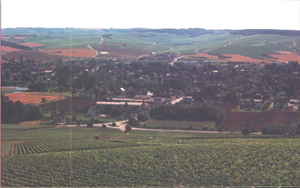 Burgundy, France. "Chablis is a sleepy town, I was surprised," remarks British-born Claire Townsend who for the last year has been studying the wine trade in this small Burgundian town. "I would call it a hive of bees," counters Annick Perrin, whose family has cultivated vines for generations. "To call it quiet is an illusion." For the visitor, Chablis holds many charms. The modesty of the town square, lined with houses in cream Burgundian stone, is deceptive. Veritable mansions crowd the crooked streets, their facades studded with carved stone alcoves, pediments, dormer windows, a testimony to the wealth of the wine trade. Once a year, at the end of November, Chablis celebrates its wines with a Fete du Vin, while in February it is the turn of the dozen surrounding villages. By turns each one decorates the streets and quaffs the new vintage (only the lowest grade -- good Chablis is too prized to drink in its infancy).
Claire Townsend works for Domaine Laroche, one of the most respected growers whose wines are exported worldwide. "Locals say that Chablis is the most imitated wine in the world," says Claire and looking at the collection of wine labels on the wall, they have a point. California, Chile, Argentina, Canada, Australia's Hunter and Barossa Valleys are just a start of the regions which have traded on the reputation of Chablis. None approach the quality of the original, described by writer Hugh Johnson as "firm, well-rounded, smooth but stony. " The stone comes from the soil, a curious outcropping of an ancient seabed encrusted with shells. That is why, say connoisseurs, Chablis marries so well with shellfish. Fine wine and good food are inseparable.
Wandering back from the river Serein (the serene) with its old wash-house and natural pool for a swim, I notice passersby with tempting bags of golden girolles mushrooms and track them down to a corner grocery store. A few windows away on the town square, AAAAA marks the seal of approval of l'Association Amicale des Amateurs d'Authentiques Andouillettes. Only in France could sausages of pigs' guts arouse such enthusiasm, but here andouillettes have their addicts. "Everything is done by hand" explains specialist Madame Soulie, "the cleaning, scalding, stuffing, everything. My grandfather started the business." For the fainter-hearted, the andouillette terrine at the nearby charcuterie offers a milder initiation.
At the Sunday market in the center of town, stalls crowd the shopfronts. The charcutier offers a slice of sausage to taste, the poultry man prepares your chicken to order, with or without the head. Local cheeses include soft-paste soumaintrain and Epoisses, creamy and redolent not to say reeking. I find farmer cow and goat cheeses, some so fresh they can be sprinkled with sugar to eat with a spoon, others mature enough to be crusted with a white mold, and a few aged goat cheeses, piquant and crumbling under the knife -- my favorites. Goat cheese also comes wrapped in bacon, a trick you might like to try: wrap a round goat cheese, the fresher the better, in thinly sliced bacon, overlapping it as little as possible. Set the cheese in a heatproof dish and bake in a 350F/l75C oven for l0-l5 minutes until the bacon is crisp and the cheese starts to melt -- perfect with a green salad. The traditional Sunday snack in Chablis are gougÎres (giant cheese choux puffs) washed down with a glass of wine.
Back to Claire Townsend: "You've a choice of four basic types of Chablis," she explains. "Petit Chablis is the simplest, best drunk fresh and young within two or three years. Plain Chablis is similar, with more body." She goes on to talk of Chablis Premier Cru, and of the Grand Crus -- world class wines which come from tiny patches of vines, and each with characteristics distinguishable by the experts. Then there's the year to consider: the Chablis of l990 is exceptional if you can find it; l99l to 93 is average and as for l994, forget it. If you are laying in stocks, last year was great but too young yet to drink. This year, volume of the harvest is average and hopes for quality are high. For an update, call on Claire for bilingual gossip and a glass at Domaine Laroche at the corner of the square.
By autoroute, Chablis is only 2 hours south of Paris and thus an ideal weekend destination. For country comfort after a long drive, try the Hostellerie du Clos (fax 86.42.10.63), installed in an old priory and with one of the best restaurants in the area. Simpler alternatives in the surrounding villages include the Relais St. Vincent (fax 86.47.54.16) in Ligny-le-Chatel with a pleasant traditional restaurant, and the b-and-b Le Moulin (fax 86.73.95.21) at Poilly-sur-Serein.

Jambon Chablisienne
Serves Four
In Chablis, this piquant little sauce, based on white wine with shallot, vinegar and juniper, is traditional with cooked ham. It is also good with cooked sliced beef or pork, particularly chops. Any dry white wine can be used. Sauteed squash or pumpkin puree is a good accompaniment.
l teaspoon juniper berries
l teaspoon black peppercorns
l/4 cup white wine vinegar
l cup dry white wine
5 tablespoons butter
5 shallots, finely chopped
2 tablespoons flour
l cup veal or chicken stock, or water
salt and pepper
2 teaspoons tomato paste
l/4 cup heavy cream
4 thick slices cooked country ham (about l pound)
Put the juniper berries and peppercorns in a plastic bag and crush them with a heavy pan or rolling pin. Put them in a small saucepan, add the vinegar and boil until reduced by half. Add the wine and boil again until reduced by half.
Meanwhile melt 3 tablespoons of the butter in a saucepan, add the shallots and saute until soft but not brown, 2-3 minutes. Stir in the flour and cook until foaming. Whisk in the stock or water and bring to a boil, whisking constantly until the sauce thickens. Add the reduced wine mixture into the sauce and stir in the tomato puree and cream. Bring the sauce to a boil, taste and adjust seasoning. Keep it warm.
Melt remaining butter in a large frying pan, add ham slices and saute until brown, 2-3 minutes on each side. Transfer ham to warm individual plates and spoon over the sauce.
Anne Willan is the founder of the famous French cooking school, LaVarenne, and has also served as president of the International Association of Culinary Professionals. She is the author of over a dozen internationally published cookbooks.
Note: This information was accurate when it was published. Please be sure to confirm all rates and details directly with the businesses in question before making your plans.


